
What are tailings?
Tailings are finely ground rock that remains after valuable minerals have been extracted from ore during the milling process. Particle sizes typically range from sand-sized grains to fine silt and clay. Tailings can also contain heavy metals and reagents used in the separation process.
Larger, sand-sized particles are often separated, mixed with cement and used as backfill in the underground mine; this is considered the safest method of tailings disposal. The finer silt- and clay-sized particles are mixed with water to form a slurry and then pumped to a tailings dam for storage.
Types of Tailings
Tailings can be stored in several types of engineered facilities, each characterised by a different water content:
Conventional facility: high water content, typically between 1 and 10 parts water to 1 part solids.
Paste tailings facility: water is partially removed before storage, resulting in approximately 1 part water to 3 parts solids.
Filtered tailings facility: water is removed through filtration, leaving approximately 1 part water to 5 parts solids.
Types of Dam Construction
Mining companies build dams to contain tailings. These dams are often enlarged as mining progresses over several years.
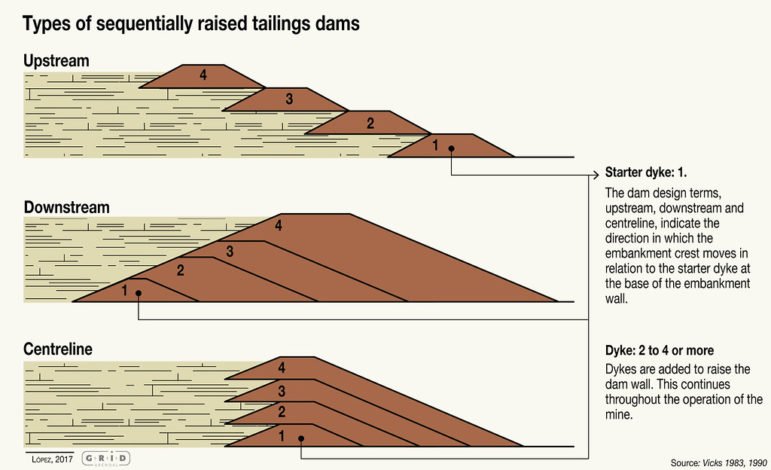
Upstream A starter dam is built first. As more capacity is required, a new “raise” is constructed on top of the existing dam wall and the previously deposited tailings. This is generally considered the least stable construction method, but it requires less material and is therefore less costly for the mine. It is prohibited in many jurisdictions.
Downstream Each raise is built on top of the previous dam wall and extends outwards, away from the tailings. This is considered the safest type of structure because it does not rely on tailings for wall support. However, it requires substantially more construction material and is therefore more costly.
Centreline A mix of both the above methods
Why are tailings a problem?
Tailings dams are built to store material that mining companies classify as waste, which may contain potentially harmful residues. Because these facilities do not generate revenue, operators may face commercial pressure to minimise costs while still meeting regulatory and engineering requirements. Tailings dams are also developed in stages over time, during which mine ownership, design engineers and construction firms may change.
Once mining ceases, the mining company may be required to maintain the structure for a defined period after closure, after which responsibility may pass to local government. Like any engineered structure, a tailings dam requires permanent monitoring and maintenance. Without upkeep, buildings, bridges and other structures deteriorate, and tailings dams are no different. A mine may operate for 10 to 50 years, but its tailings facility can remain indefinitely.
Tailings dam collapses
According to studies cited by WISE (World Information Service on Energy), there have been 257 tailings dam failures since 1915, resulting in approximately 2,650 fatalities, including around 640 deaths since 2000.
Recent incidents of note include:
2019 Brumadinho dam failure in Mina Córrego do Feijão, Minas Gerais, Brazil
270 fatalities and 10 million cubic metres of waste released.
2015 Fundão tailings dam near Mariana, Minas Gerais, Brazil
19 fatalities and 40 to 60 million cubic metres of waste released.
1998 Los Frailes tailings dam failure, Seville, Spain - Operated by Boliden at the time of the collapse
6 million cubic metres released, 4,200 hectares of land covered and 60 kilometres of rivers contaminated.
On average, five to six major tailings dam failures occur annually. Approximately 25% of failures globally and 35% in Europe are attributed to heavy rainfall. Given the predicted increase in the severity and frequency of extreme weather events due to climate change, this is a significant concern.
Tailings dam standards
Since 2020, the mining industry has adopted a set of voluntary guidelines known as the Global Industry Standard on Tailings Management (GISTM). Before its introduction, standards were primarily set through local governance.
The standards do not provide guidance on exclusion zones between tailings facilities and residential areas. Environmental organisations and NGOs have criticised the EU for not implementing this type of zone, as adopted in China, where the stated minimum is 1 kilometre, and in several South American countries, including Brazil, where a 10-kilometre downstream zone is cited.
Boliden Tara Mines Randalstown Tailings Facility
The Randalstown tailings facility is a conventional facility that stores waste produced by Boliden Tara Mines. It serves Europe’s largest zinc mining operation and is located among Navan’s northern townlands.
The tailings slurry is pumped approximately 3 km from the mine, beneath the Blackwater River and along the Boyne Valley to the Lakelands Greenway, where it is stored in a 255-hectare (630-acre) waste facility, currently estimated to contain over 50 million tonnes of waste.
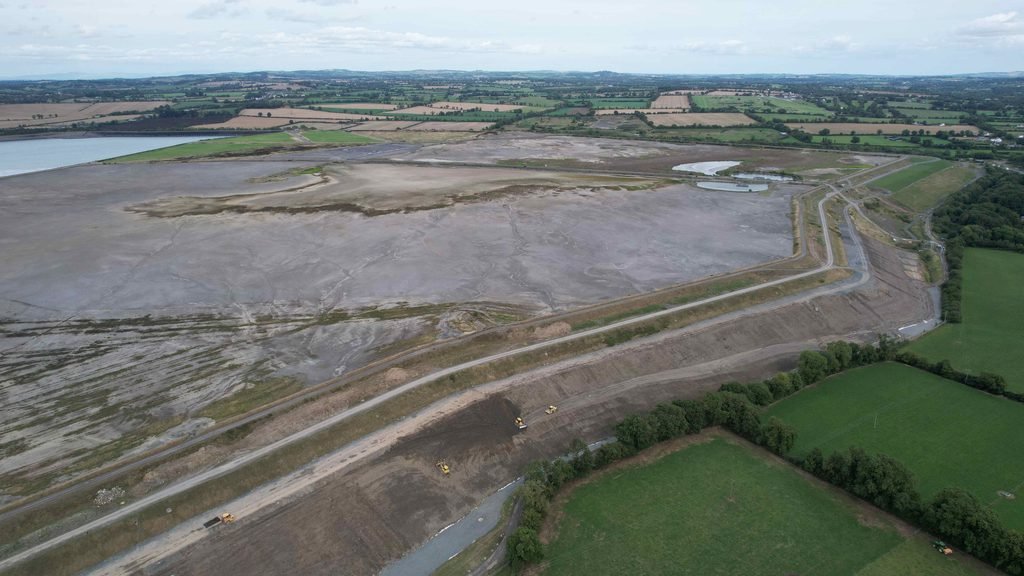
The original dam was constructed in the mid-1970s, and two upstream raises were added from the late 1990s onwards. This section of the facility is undergoing buttress construction—a large soil-and-rockfill structure built against the face of the existing dam—to strengthen the walls of the original dam and the upstream raises.
The latest extension was constructed in two stages between 2018 and 2023. First, a starter dam was built off the north wall of the existing dam. A downstream raise was then added to bring the extension to the same height as the existing facility. Unlike the original unlined dam, this extension was lined with high-density polyethylene (HDPE).