
Report on guest speakers at the SENT community meeting, 15 September 2026
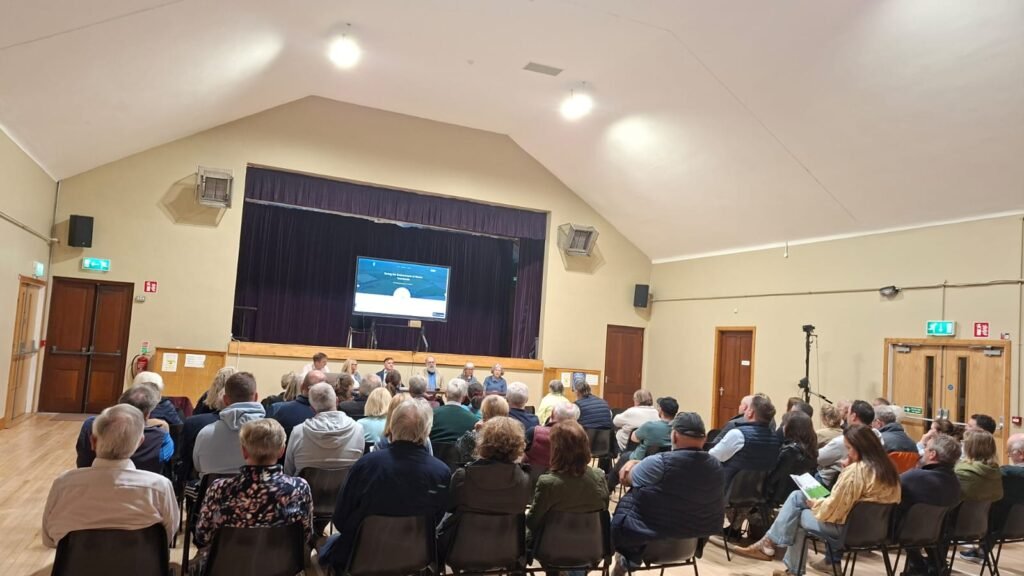
The meeting heard from two guest speakers. Lynda Sullivan of An Taisce placed Tara Mines in the wider context of mining in Ireland, including the long-term impacts of closed mines and the land taken up by tailings facilities. Dr. Steven Emerman of Malach Consulting then examined the Tara Mines tailings storage facility dam safety review by SLR Consulting, highlighting serious concerns about construction methods, water volumes, seepage, stability and emergency planning.
Lynda Sullivan – An Taisce
Lynda began by outlining the history of mining in Ireland. She referred to the Avoca mines in Co. Wicklow and Silvermines in Co. Tipperary, noting that both continue to have consequences 25 to 35 years after closure. She then discussed Aughinish Alumina in Co. Limerick and Tara Mines in Co. Meath, focusing on the large areas of land taken up by tailings dams.
Lynda questioned the need for continued mining, arguing that much of the demand is driven by profit, wealth and a culture of newer products with built-in obsolescence. She noted that the mining industry also points to renewable energy, climate action, data centres and AI technology as reasons for further mineral extraction. However, she argued that mining remains one of the most carbon-intensive and habitat-damaging industries on earth.
Lynda also challenged the narrative that mining jobs should outweigh other concerns. She said there have been many occasions when mining company in Navan closed operations during periods of low commodity prices, leaving workers laid off, dependent on government support and facing renegotiated terms before returning to work.
In conclusion, Lynda said responsibility rests with government for facilitating mining and associated waste facilities in Ireland without proper consideration for the communities left to deal with them long after mining companies and jobs are gone. She ended by saying that Tara Deep and a new tailings facility would be ludicrous given the unresolved threat posed by the existing mine and tailings facility.
Dr. Steven Emerman – Malach Consulting
Dr. Emerman began by explaining different methods of dam construction. He said that Stages 1 to 5 of the Tara Mines Randalstown tailings facility were built using the upstream method, in which dam raises are constructed largely on top of previously deposited tailings. He described this as the least favourable and least stable method of construction.
Dr. Emerman then summarised and interpreted the Tara Lead/Zinc Mines Tailings Storage Facility Dam Safety Review, prepared by SLR Consulting for Boliden Tara Mines in December 2022. The review was partially based on a dam break analysis carried out by Golder in 2021. He highlighted that SLR noted Boliden Tara Mines had not provided all the information requested to complete the report.
For the later Stage 6 extension, Dr. Emerman noted that this section was composite lined and built using the more favourable downstream method. However, he said the dam slopes are excessively steep when compared with industry standards and European Commission recommendations.
The report also stated that water volumes in the dam are excessive. In Stage 6, they are two to four times higher than the values used in the design process. Dr. Emerman said this increases both the likelihood and the consequences of failure. He also noted that there are no emergency spillways to prevent overtopping or slope failure during an extreme storm.
Dr. Emerman also pointed out that, according to the report, the tailings pond had been under-designed because no allowance was made for wave run-up in a deep water body, and flood estimates need to be reviewed in light of climate change. The report further stated that the high water level in the dam is partly due to the long pumping distance, which requires low solids levels of 15% in the pipeline and therefore a high volume of water to move the waste material.
SLR noted that seepage was occurring from the dam, being captured in the perimeter interceptor channel and pumped back into the facility. However, the report also indicated that groundwater to the southwest was being affected by seepage. Prof. Emerman added that some monitoring by Boliden Tara Mines was inadequate, with elevated readings going undiscovered for weeks.
Dr. Emerman then outlined what he described as the biggest concern of the night: the safety review indicated that the tailings dam is considered unstable because the target factor of safety of 1.5 is not met across almost all of the facility. One section had a factor of safety of 1.6, while the remainder ranged from 1.0 to 1.4. He said that, in many jurisdictions, figures of this kind would require an immediate halt to further tailings placement and, in some areas, evacuation of downstream residents.
The report recommended building a buttress to stabilise the dam walls. Prof. Emerman noted, however, that the report also warned that building the buttress too rapidly could destabilise the tailings or the foundation.
Dr. Emerman also discussed the report’s findings on population at risk and potential loss of life. The 2021 dam break analysis by Golder identified 41 households at risk and estimated a potential loss of life of 1.1 persons. SLR concluded that these figures were likely underestimated because Stage 6 contains far more material than the volume used in the analysis and because the strength of the tailings was much lower than assumed in the calculations. SLR also found that the range of possible failure locations considered was inadequate, meaning the emergency response plan did not cater for all possibilities.
Overall, the meeting presented two connected concerns: the long-term social and environmental legacy of mining in Ireland, and the specific safety questions raised about the Tara Mines tailings storage facility. Both speakers emphasised that communities can be left carrying the risks and consequences of mining decisions long after companies, jobs and active operations have moved on.